Best HWID Spoofer, How Hardware ID Spoofing Tools Work and What to Check Before Buying
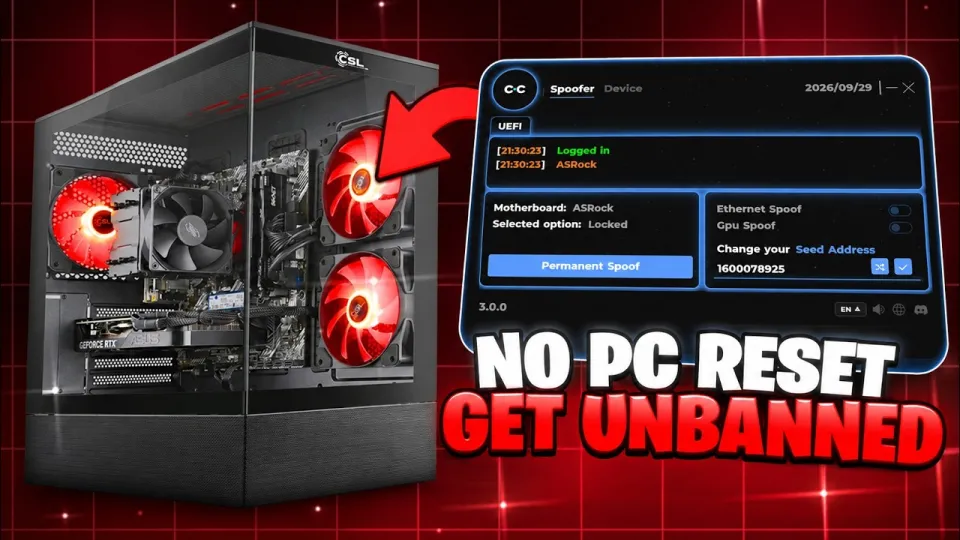
· based on the channel clixx
Key takeaways
- An HWID spoofer replaces the hardware identifiers a game or anti-cheat reads — disk serials, SMBIOS/motherboard data, MAC addresses, volume IDs and registry traces — so a banned machine looks like a new one.
- The tool covered in the clixx breakdown is distributed through cethcheats.cc, with support handled on the Discord server at discord.gg/ceth and a 5% discount code DENYS.
- Advertised game support includes Fortnite, Warzone, Rust, CS2, Rainbow Six Siege, Apex Legends and Valorant.
- The video walks through the interface, feature list, configuration settings and installation, and splits spoofing into permanent and temporary modes.
- Spoofing changes identifiers only — it does not remove a ban from the game account itself, and anti-cheat vendors actively detect known spoofer signatures.
The best HWID spoofer is a tool that rewrites the hardware identifiers an anti-cheat reads — disk and volume serials, SMBIOS and motherboard strings, MAC addresses and related registry entries — so a machine flagged by a hardware ban presents itself as a clean system. The tool shown in the clixx tutorial is sold through the Ceth Cheats store, where you can pick a license, register an account and apply a discount code at checkout. This guide explains what such software actually changes, how the setup process runs, which games are covered, and where the real limits are.
What an HWID spoofer changes on your PC
A hardware ID ban does not live in your game account; it lives in the fingerprint the anti-cheat builds from your machine, which is why a fresh account on the same PC can be flagged within minutes. A spoofer targets that fingerprint layer by layer:
- Storage identifiers — the serial number of the physical drive and the volume serial of the system partition.
- SMBIOS and motherboard data — BIOS vendor strings, baseboard serial, system UUID and chassis information.
- Network adapters — the MAC address of the active Ethernet or Wi-Fi adapter, plus the associated registry keys.
- Windows and registry traces — machine GUID, product ID leftovers, and game-specific registry folders that persist after an uninstall.
- Peripheral and display data — monitor EDID strings and, in some builds, connected device serials.
The video's feature overview follows the same logic: the interface exposes separate toggles for disk, SMBIOS, network and registry cleaning rather than a single button, and the configuration screen is where you decide which of those get rewritten on each run.
Permanent vs temporary spoofing: which mode to pick
Permanent spoofing writes new identifiers that survive a reboot until you deliberately revert them, while temporary spoofing applies changes for the current session and restores the originals afterwards. In practice:
- Permanent mode suits a machine that has been hardware banned and will keep being used for the same game; you spoof once, reboot, and the new IDs stay in place.
- Temporary mode suits shared or work PCs, or players who want to test whether a spoofer is compatible with their system before committing to a full rewrite.
- Revert option matters either way: a reputable tool stores your original values so you can roll back, and the absence of a clean restore path is a red flag.
The trade-off is detection. Permanent changes are the ones anti-cheat vendors fingerprint most aggressively, so a build that is not updated after a detection wave is worse than useless — it can get a clean account banned on the first launch.
Supported games and compatibility
The breakdown lists Fortnite, Warzone, Rust, CS2, Rainbow Six Siege, Apex Legends and Valorant as supported titles, which covers most of the competitive shooters where hardware bans are common. Compatibility is not just about the game, though:
- Windows version matters — Windows 10 and Windows 11 builds handle SMBIOS writes differently, and some spoofers only support specific builds.
- Storage layout matters — NVMe drives, RAID arrays and BitLocker-encrypted volumes can block serial rewrites.
- Secure Boot and TPM can prevent the tool from touching the identifiers it needs; many spoofers ask you to disable them temporarily.
- FiveM and Rust servers are a separate case: server-side bans on community platforms often rely on identifiers the game itself collects, so results vary by server.
Check the vendor's supported-game list against your exact Windows build before paying for anything, and treat "works on everything" claims as marketing rather than a specification.
Step-by-step setup from the tutorial
The installation walkthrough in the video is short and follows a standard pattern for this category of software:
- Download the loader from the official store page — not from a mirror or a reupload.
- Create an account and enter a license key; the video's coupon code DENYS takes 5% off at checkout.
- Disable antivirus real-time protection temporarily, since spoofers modify low-level system data and are almost always flagged as riskware.
- Launch the loader as administrator, then open the configuration tab and select which identifier groups to rewrite.
- Choose permanent or temporary mode, apply, and reboot the machine so the new values are read at startup.
- Verify the result with a hardware info utility before launching the game.
If the loader fails at step 4, the usual causes are a pending Windows update, Secure Boot still enabled, or an antivirus quarantine that silently removed a driver.
Risks, detection and realistic expectations
Spoofing is an arms race, and no tool wins it permanently. Anti-cheat developers push signature updates that detect known spoofers, and a detected spoofer can flag the machine it runs on even if the game account was clean. Beyond detection, there are practical risks: kernel-level drivers from unknown vendors, loaders that request more access than they need, and licenses that stop working after a detection wave with no refund. The clixx video is a software overview, not an independent test — it shows the interface and the install flow, but a single walkthrough cannot prove undetectability over weeks. If you go ahead, use a secondary account first, keep the loader updated, and never run a spoofer on a machine that holds accounts you care about.
Where to get the tool and support
The software in the tutorial is distributed through the official store and supported on the vendor's community server:
- Store and licenses: https://cethcheats.cc/
- Discord support: https://discord.gg/ceth
Buying from the store page rather than a third-party reseller is the only way to guarantee you get the current build and a working license key; the Discord is where update announcements and troubleshooting threads appear.
Summary
An HWID spoofer rewrites the hardware fingerprint an anti-cheat uses to ban a machine, and the tool covered in the clixx breakdown handles disk serials, SMBIOS data, MAC addresses and registry traces through a toggle-based interface with permanent and temporary modes. Setup is a short sequence — download, license, disable antivirus, run as administrator, configure, apply, reboot — and the advertised game list spans Fortnite, Warzone, Rust, CS2, Rainbow Six Siege, Apex Legends and Valorant. The honest caveat is that spoofing is a moving target: detection updates arrive regularly, and a tool that works today can be flagged next month. If you want to try it, start at the Ceth Cheats store, apply code DENYS for 5% off, and keep the Discord open for update news. Thanks to clixx for the video breakdown that this guide is based on.
Source: The Ultimate HWID Spoofer Tutorial 2026 – Full Guide To Get Unbanned Fast · Markdown version
Questions & answers
Does an HWID spoofer remove my game ban?
No. A spoofer changes the hardware identifiers your PC reports; it does not unban a game account. A hardware ban blocks the machine, so spoofing lets a new account run on that machine, but the original banned account stays banned.
Is a free HWID spoofer safe to use?
Free spoofers are usually older leaked builds that anti-cheat vendors already detect, and they often ship with bundled malware or request kernel-level access without any support channel. If something goes wrong there is no vendor to fix it, which is why paid tools with an active update cycle are the common choice.
How long does HWID spoofing last?
In permanent mode the new identifiers stay until you revert them or reinstall Windows, while temporary mode resets after a reboot. Either way, the practical lifespan depends on detection: once anti-cheat vendors add the spoofer's signature, the tool needs an update before it is usable again.
Which games are covered by the spoofer in the clixx tutorial?
The video lists Fortnite, Warzone, Rust, CS2, Rainbow Six Siege, Apex Legends and Valorant, plus FiveM servers. Compatibility still depends on your Windows build, storage configuration and whether Secure Boot or TPM is enabled.